
The End of Traditional Training Has Already Begun
Workforce training is no longer evolving gradually. It is being fundamentally reshaped.
For years, organisations accepted slow course creation, static content, and reactive compliance tracking as the norm. Training was something that happened in the background—necessary, but rarely strategic. That model held up when change was slow and workforces were centralised.
That is no longer the case.
Today, organisations such as aerospace and defence companies operate in environments defined by constant change. Regulations shift, workforces are distributed, and expectations around speed and accountability have increased dramatically. Training is expected to keep pace with operations, not lag behind them.
Artificial intelligence is not simply improving this process. It is replacing the underlying model entirely.
What Is AI in Workforce Training?
AI in workforce training refers to the use of intelligent systems to create, deliver, and continuously improve learning experiences.
At its core, it allows organisations to move away from manual course development and towards systems that can generate structured training automatically. Policies, procedures, and operational knowledge can be transformed into learning content in minutes rather than weeks.
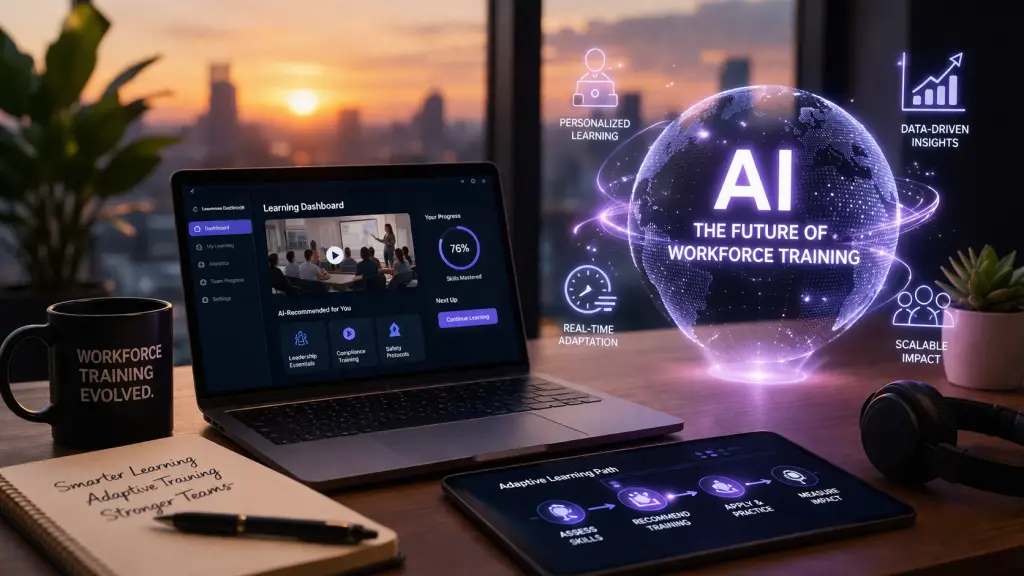
More importantly, AI introduces adaptability. Training is no longer fixed. It can respond to roles, environments, and changing requirements in real time, making learning more relevant and more effective.
AI Is Not a Feature — It’s the Foundation
Many platforms still present AI as an enhancement—something layered on top of existing systems. This typically includes automated quizzes, summaries, or content suggestions.
This framing misses the bigger shift.
AI is not an add-on. It is becoming the foundation of how training systems are designed and operated. It changes not just what training looks like, but how it is created, managed, and used within an organisation.
The most significant transformation is happening across three areas: the speed of course creation, the adaptability of learning experiences, and the visibility organisations have over workforce capability.
From Weeks to Minutes: Rethinking Course Creation
How does AI create training courses?
AI can take structured or unstructured information—such as policies, procedures, or even a simple prompt—and convert it into a fully formed training course.
Instead of coordinating multiple stakeholders and spending weeks building content manually, organisations can generate modules, assessments, and supporting materials almost instantly. Voiceovers, quizzes, and structured learning paths are created as part of the same process.
This shift removes one of the most persistent bottlenecks in training. It allows organisations to respond immediately to new requirements, rather than delaying implementation while content is developed.
The impact is not just speed. It is the ability to treat training as a live, responsive function of the business.
From Static Content to Intelligent Learning Systems
Traditional eLearning was built on the idea of fixed content. Once created, a course remained largely unchanged, regardless of how roles, risks, or environments evolved.
AI changes this dynamic entirely.
Training becomes adaptive. Content can be aligned to specific roles, updated as conditions change, and delivered in a way that reflects real-world requirements. Instead of a single version of a course being delivered to everyone, learning becomes more precise and contextual.
This is particularly important in industries where conditions are constantly shifting. Whether it is a construction site, a manufacturing environment, or a compliance-driven organisation, static training simply cannot keep up with operational reality.
AI introduces a system that can.
From Compliance Tracking to Workforce Intelligence
What is real-time compliance tracking?
Real-time compliance tracking uses AI to continuously monitor training completion, certification status, and workforce competency across an organisation.
Historically, compliance has been retrospective. Reports are generated, gaps are identified, and action is taken after the fact. This creates risk.
AI enables a different approach. Organisations can see their training and compliance position as it stands, not as it was. They can identify gaps early, respond quickly, and maintain a consistent standard across teams, sites, and roles.
More importantly, this visibility extends beyond compliance. It provides insight into capability—what the workforce knows, where weaknesses exist, and where training is needed most.
Training moves from administration to intelligence.
Why Traditional Training Models Are Failing
The limitations of traditional training are no longer theoretical—they are operational.
Organisations are dealing with increasing complexity, yet relying on systems that were designed for stability. Course creation is too slow, content is too generic, and visibility is too limited.
This creates friction at every level. Training becomes difficult to manage, hard to scale, and disconnected from real business needs.
AI does not simply improve these systems. It removes the constraints entirely, replacing them with something faster, more flexible, and far more aligned to how organisations actually operate.
What the Next Generation of Learning Platforms Looks Like
The next generation of learning platforms is already emerging, and it looks fundamentally different from what came before.
Speed is no longer a differentiator—it is expected. Training must be created and deployed as quickly as the business moves. Flexibility is built in, allowing content to adapt to roles, environments, and requirements without constant manual intervention.
Intelligence sits at the centre. Platforms do not just store data; they interpret it, providing clear insight into workforce capability and risk. Integration ensures that learning is embedded into wider systems, rather than operating in isolation.
Accessibility is also critical. Training must work across devices, locations, and languages, ensuring that it reaches the entire workforce without barriers.
Platforms like Neurofy are designed around these principles, using AI not as an enhancement, but as the foundation of the system itself.
What This Means for Organisations Today
Organisations that adopt AI-driven training are not simply improving efficiency—they are changing how they operate.
Training becomes faster to deploy, easier to manage, and more aligned to real-world needs. Compliance becomes more reliable because it is continuously monitored, rather than periodically reviewed. Administrative overhead is reduced, allowing teams to focus on higher-value work.
At the same time, learning becomes more engaging and relevant for the workforce. Content reflects the environments people actually work in, rather than abstract or outdated scenarios.
The result is a system that supports performance, rather than simply documenting activity.
The Future Is Smarter, Not Bigger
There is a common assumption that AI will lead to an explosion of training content.
In reality, it is leading to something far more valuable.
The future of training is not about producing more material. It is about delivering the right learning experience at the right moment, in a way that is directly relevant to the individual.
AI enables this level of precision. It allows organisations to move away from volume and towards impact.
This is where the real value lies.
Frequently Asked Questions
What is AI in workforce training?
AI in workforce training uses intelligent systems to create, deliver, and optimise learning content, making training faster, more scalable, and more relevant to real-world needs.
How does AI create training courses?
AI can convert documents, policies, or simple prompts into structured training courses with modules, assessments, and voiceovers in a matter of minutes.
Is AI-generated training compliant?
AI-generated training can support compliance when it is aligned with organisational policies and regulatory requirements, while also providing clear audit visibility.
Can AI replace traditional eLearning?
AI is transforming traditional eLearning into adaptive systems that respond to changing roles, risks, and operational environments.
What are the benefits of AI in training?
The key benefits include faster course creation, reduced administrative effort, improved compliance visibility, and more relevant learning experiences.
How quickly can AI build training content?
In most cases, AI can generate complete training courses in minutes, significantly reducing the time required compared to traditional methods.
Final Thought: Training Is Becoming a Competitive Advantage
Training has long been treated as a requirement—something that must be done to meet compliance standards.
That perception is changing.
As AI reshapes how training is delivered and managed, it is becoming a core part of how organisations operate. It supports performance, reduces risk, and enables growth in a way that traditional systems never could.
The organisations that recognise this shift will not just improve their training. They will strengthen their entire operation.
Ready to Rethink Workforce Training?
The question is no longer whether AI will transform training.
It is whether your organisation is ready to take advantage of it.