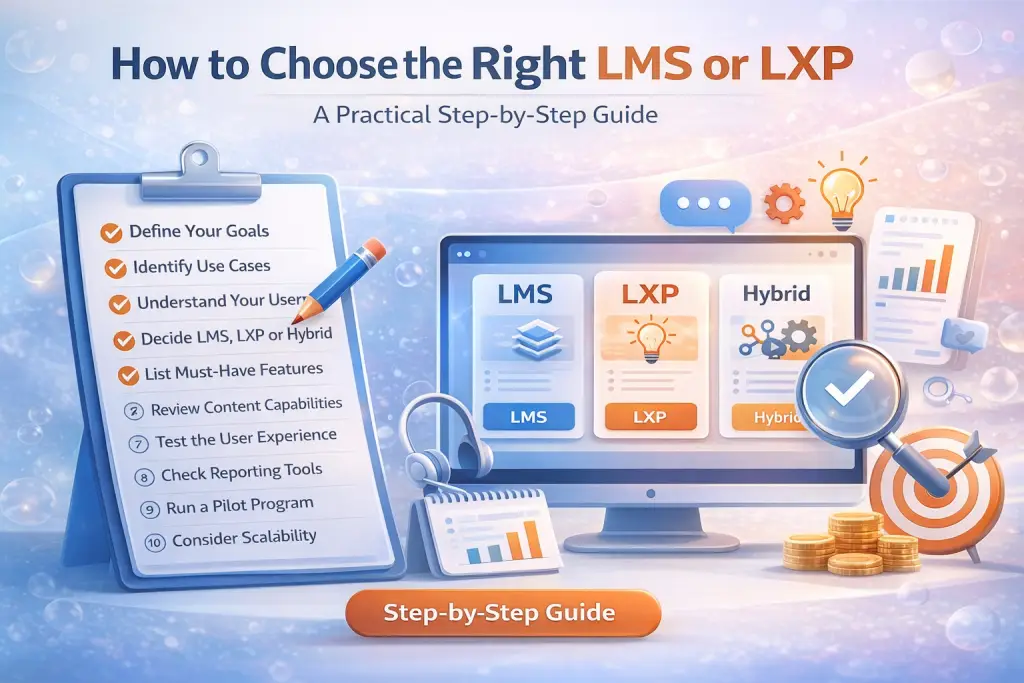

Choosing a learning platform is one of those decisions that looks simple on the surface — until you realise how many options, features, and opinions are out there.
Pick the wrong system, and you’ll end up with:
- Low engagement
- Frustrated users
- Poor adoption
- Wasted budget
Pick the right one, and it becomes a powerful tool that drives compliance, improves performance, and builds a genuine learning culture.
This guide walks you through exactly how to make the right choice.
Step 1: Define What Problem You’re Actually Solving
Before looking at platforms, get clear on your primary objective.
Ask yourself:
- Do we need to track mandatory training?
- Are we struggling with low engagement?
- Do we want to upskill staff continuously?
- Is compliance or culture the bigger priority?
Quick Decision Filter
- If your main goal is compliance and tracking → You need an LMS
- If your main goal is engagement and development → You need an LXP
- If it’s both → You need a hybrid solution
Most organisations fall into the third category.
Step 2: Identify Your Core Use Cases
Be specific about how the platform will be used day-to-day.
Typical LMS Use Cases
- Health & safety training
- Onboarding programmes
- Compliance certifications
- Policy acknowledgement
Typical LXP Use Cases
- Leadership development
- Soft skills training
- Continuous professional development
- Knowledge sharing
Write down your top 5 use cases. If a platform can’t handle these well, it’s not the right fit.
Step 3: Understand Your Users (This Is Where Most Go Wrong)
Many businesses choose platforms based on admin features — not user experience.
That’s a mistake.
You need to consider:
- Are your users desk-based or frontline?
- How tech-savvy are they?
- Will they use mobile devices?
- Do they want to learn — or are they being told to?
Reality Check
If your workforce is:
- Busy
- Mobile
- Not naturally engaged with training
Then user experience is everything.
A clunky system will fail — no matter how powerful it is.
Step 4: Decide on LMS vs LXP vs Hybrid
At this point, the direction should be clearer.
Choose an LMS if:
- Compliance is critical
- You need detailed reporting
- Training must be structured and controlled
Choose an LXP if:
- Engagement is your biggest issue
- You want self-directed learning
- You’re building a learning culture
Choose Hybrid if:
- You want long-term scalability
- You need both compliance and engagement
- You’re modernising your learning strategy
Tip: Most modern platforms are moving toward hybrid — but not all do it well.
Step 5: Define Your Must-Have Features
Avoid being distracted by long feature lists. Focus on what actually matters.
Essential LMS Features
- Course management
- Compliance tracking
- Certifications
- Reporting & audit trails
Essential LXP Features
- AI recommendations
- Personalised learning paths
- Content aggregation
- Social learning features
Modern Must-Haves (Non-Negotiable)
- Clean, intuitive interface
- Mobile-friendly design
- Fast performance
- Integration capabilities
- Automation (to reduce admin workload)
Step 6: Check Content Creation Capabilities
This is often overlooked — and it’s critical.
Ask:
- Can you create courses easily?
- Does it support AI course creation?
- Can subject matter experts contribute content?
- How fast can you update training?
If content creation is slow or expensive, your platform will quickly become outdated.
Step 7: Evaluate Reporting (Without Overcomplicating It)
Reporting matters — but only if it’s usable.
Look for:
- Clear dashboards
- Easy export of reports
- Real-time tracking
- Compliance visibility
Avoid platforms that:
- Overwhelm with data
- Require manual work to extract insights
Step 8: Test the User Experience Properly
Don’t rely on demos alone.
Instead:
- Request a trial or sandbox
- Test as both an admin and a learner
- Try completing a course
- Try finding content
- Try using it on mobile
Ask Yourself
- Is it intuitive?
- Is it fast?
- Would people actually want to use this?
If the answer is no, walk away.
Step 9: Consider Scalability and Future Needs
Think beyond today.
Ask:
- Will this platform grow with us?
- Can it handle more users and content?
- Does it support AI and automation?
- Will it still feel modern in 2–3 years?
Switching platforms later is expensive and disruptive — choose something that lasts.
Step 10: Compare Vendors (Properly)
When comparing providers, look beyond price.
What Really Matters
- Ease of use
- Support and onboarding
- Flexibility and customisation
- Speed of implementation
- Ongoing innovation
Red Flags
- Overly complex setup
- Poor support response times
- Outdated interface
- Heavy reliance on manual admin
Step 11: Run a Pilot Before Full Rollout
Before committing fully:
- Test with a small group of users
- Gather feedback
- Identify friction points
- Measure engagement
This reduces risk and helps ensure adoption.
Common Mistakes to Avoid
- Choosing based on price alone
- Ignoring user experience
- Overcomplicating features
- Focusing only on compliance
- Not involving end users in the decision
Final Thoughts
Choosing between an LMS and LXP isn’t just a tech decision — it’s a strategic one.
The best platform will:
- Meet your compliance needs
- Engage your users
- Scale with your organisation
- Reduce admin effort
- Support continuous learning
If you get this right, your learning platform becomes more than just software — it becomes a key driver of performance, culture, and growth.