
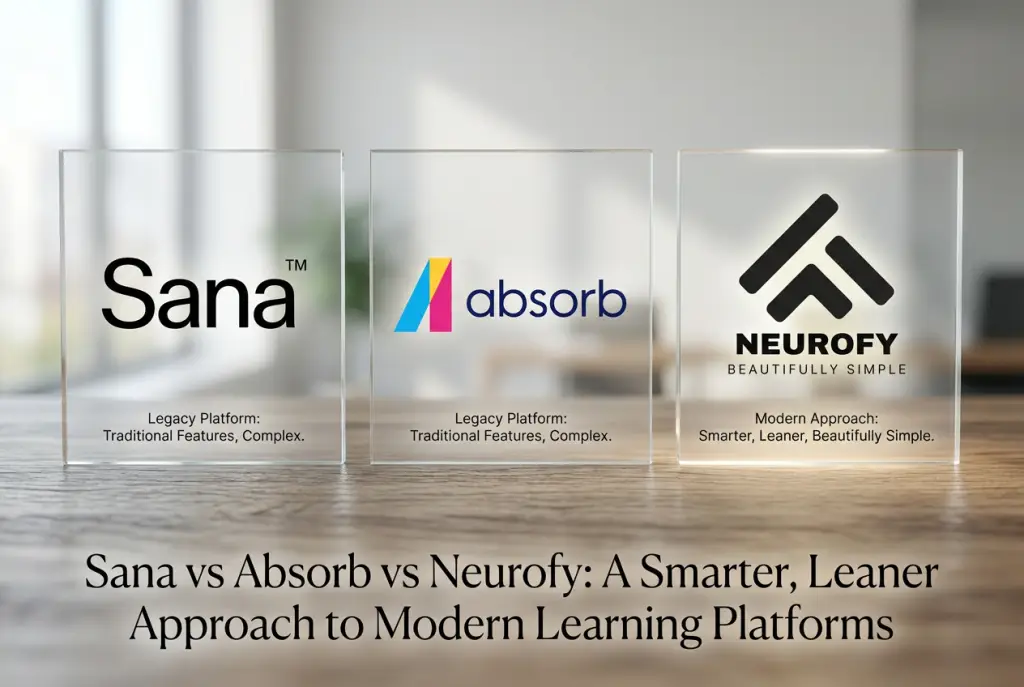

The Shift in Learning Platforms: Why Businesses Are Rethinking LMS and LXP Investments
Over the past few years, the learning technology market has evolved rapidly. Platforms such as Sana and Absorb LMShave helped redefine what organisations expect from their learning systems. Clean interfaces, AI-assisted workflows, and more engaging user experiences have replaced the rigid, compliance-only systems that dominated the past.
These platforms have, in many ways, set a new standard. They have demonstrated that learning systems can be both powerful and user-friendly, and that automation can significantly reduce the administrative burden traditionally associated with training.
However, as more organisations adopt these platforms, a new set of considerations is emerging. The conversation is no longer centred purely on capability. Instead, it is shifting towards efficiency, speed, and overall value.
The Reality Behind Enterprise Learning Platforms
There is no doubt that platforms like Sana offer a highly polished, forward-thinking approach to learning. Their use of AI, combined with a strong focus on user experience, makes them particularly attractive to large organisations looking to modernise their learning ecosystems.
Similarly, Absorb LMS continues to be a strong contender, especially for organisations that require structured training, compliance tracking, and detailed reporting. Its maturity and breadth of functionality make it a reliable choice for businesses with complex training requirements.
But in practice, many organisations are discovering that these platforms can introduce friction in unexpected ways. The issue is not capability, but proportion. For many teams, particularly those without dedicated learning and development departments, the scale and depth of these systems can feel excessive relative to their actual needs.
Implementation can take longer than anticipated, with configuration, onboarding, and internal alignment all contributing to delays before the platform is fully operational. Even once in place, the process of creating and maintaining content can still feel slower than expected, particularly when speed is critical.
Cost is another factor that is becoming harder to ignore. As organisations scale usage, add users, or unlock additional features, the overall investment can increase significantly. Over time, this can lead to a mismatch between the platform’s theoretical capability and the practical value it delivers on a day-to-day basis.
A Shift Towards Simplicity and Speed
This is where a new category of learning platforms is beginning to gain traction. Rather than building increasingly complex systems, these platforms take a different approach. They focus on reducing friction, accelerating workflows, and delivering value as quickly as possible.
Neurofy sits within this emerging space. Its approach is not to compete on the breadth of features alone, but to rethink how those features are delivered and experienced. The emphasis is on immediacy and usability — removing the barriers that typically slow down course creation, deployment, and iteration.
In practical terms, this changes how organisations interact with their learning systems. Instead of spending significant time setting up structures and workflows, they can move quickly from idea to execution. Training becomes something that can be created and deployed in response to real-time needs, rather than a process that requires long lead times.
Closing the Gap Without Adding Weight
One of the most notable developments in recent years is how quickly feature gaps have closed across the market. Capabilities that were once considered advanced — such as AI-generated content, personalised learning journeys, and integrated reporting — are no longer exclusive to enterprise platforms.
This has changed the nature of competition. The question is no longer which platform offers the most features, but which platform delivers the most usable experience.
Neurofy reflects this shift. It aligns closely with the expectations set by platforms like Sana, while maintaining a much lighter operational footprint. The experience is streamlined, the interface is intuitive, and the path from content creation to learner engagement is significantly shorter.
For many organisations, this balance is becoming increasingly important. They do not necessarily need more functionality. What they need is a system that allows them to act quickly, adapt easily, and maintain control without unnecessary complexity.
Speed as the New Differentiator
Speed is emerging as one of the most important factors in platform selection. In a business environment where priorities shift quickly and new requirements can arise at short notice, the ability to create and deploy training rapidly is a significant advantage.
Traditional systems, even modernised ones, can still carry elements of legacy thinking. Processes are structured, workflows are defined, and changes can require multiple steps. While this provides control, it can also slow things down.
In contrast, newer AI-first platforms are designed to remove these constraints. Course creation becomes almost instantaneous, updates can be made in real time, and distribution is frictionless. This fundamentally changes the role of learning within an organisation. It moves from being a scheduled activity to a responsive, ongoing capability.
A More Practical Buying Mindset
As a result of these changes, buyer behaviour is evolving. Organisations are becoming more focused on practical outcomes rather than theoretical capability. Ease of use, speed of deployment, and overall efficiency are now central considerations.
There is also a growing awareness that complexity comes at a cost, not just financially, but operationally. Systems that require significant management effort can become a burden over time, particularly for smaller teams.
In this context, platforms that offer a more streamlined approach are increasingly attractive. They provide a way to achieve the same objectives without the associated overhead.
Where Neurofy Fits in the Market
Neurofy represents a move towards a more efficient model of learning technology. It is designed for organisations that want to take advantage of modern capabilities, particularly AI, without committing to the weight and cost of traditional enterprise platforms.
Its strength lies in how it delivers functionality rather than the sheer volume of features. By focusing on speed, clarity, and usability, it enables organisations to implement and scale learning initiatives with minimal friction.
For teams that have found existing platforms to be overly complex or slow to deliver value, this approach offers a compelling alternative.
The Direction of the Market
The learning technology market is entering a new phase. The initial wave of innovation focused on adding features and expanding capability. The next phase is about refinement — making those capabilities more accessible, more efficient, and easier to use.
Platforms like Sana and Absorb LMS will continue to play an important role, particularly in large, complex environments. But alongside them, a new generation of platforms is emerging, focused on delivering similar outcomes in a more streamlined way.
For many organisations, this shift represents an opportunity to rethink their approach. Instead of defaulting to the most established or feature-rich solution, they can choose a platform that aligns more closely with how they actually work.
In doing so, they are likely to find that the most effective solution is not the one with the most features, but the one that enables them to move faster, operate more efficiently, and deliver meaningful learning outcomes with less effort.

